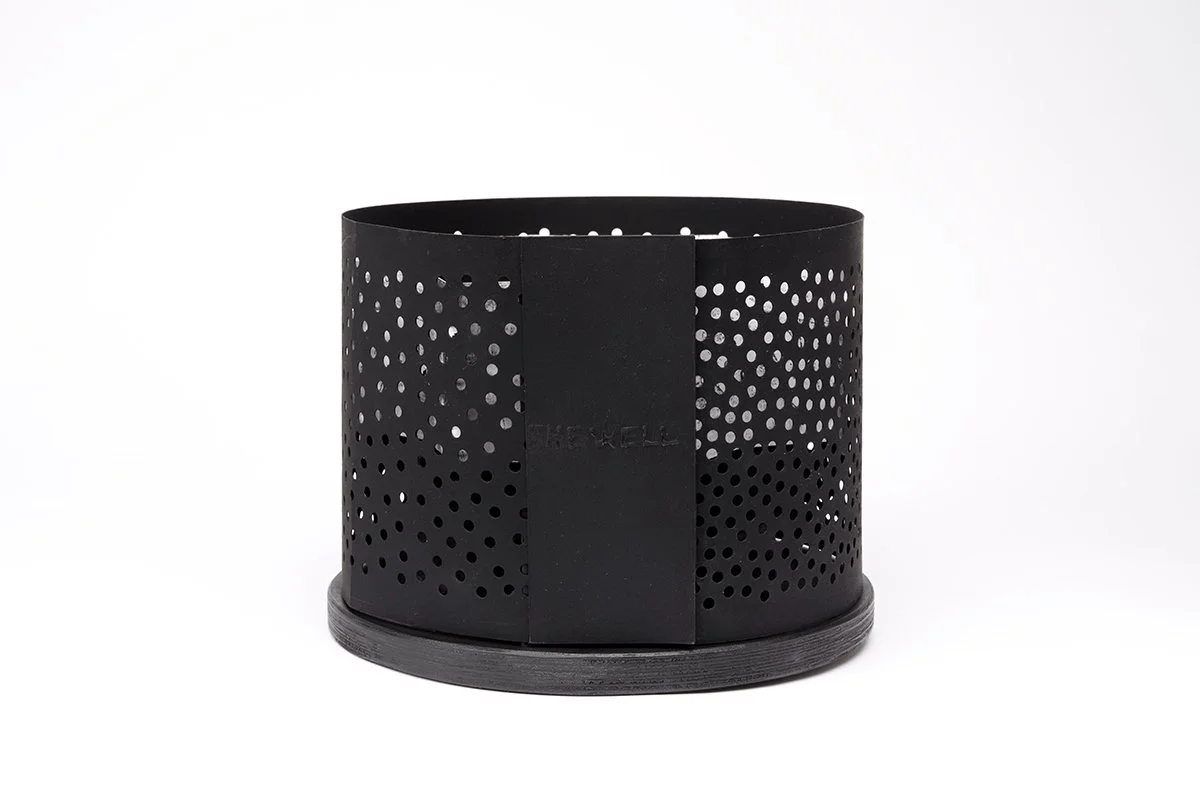
The Well, closed
The Well is a memorial to the deceased whose bodies were stolen and used for medical dissection, particularly those never recovered. My host and tour guide, IBé Crawley, mentioned that the remains of free and enslaved Africans had been discovered in a sealed refuse well during a construction project at the local medical school.
In the 19th century, Richmond was the largest slave trading port in the Upper South and not coincidentally, home to one of the oldest medical schools - the Medical College of Virginia, which would eventually become Virginia Commonwealth University. In addition to holding captive and renting enslaved laborers, faculty publicly advertised ready access to cadavers for use in medical education, and routinely conducted clinical research and experimental procedures on African-Americans.
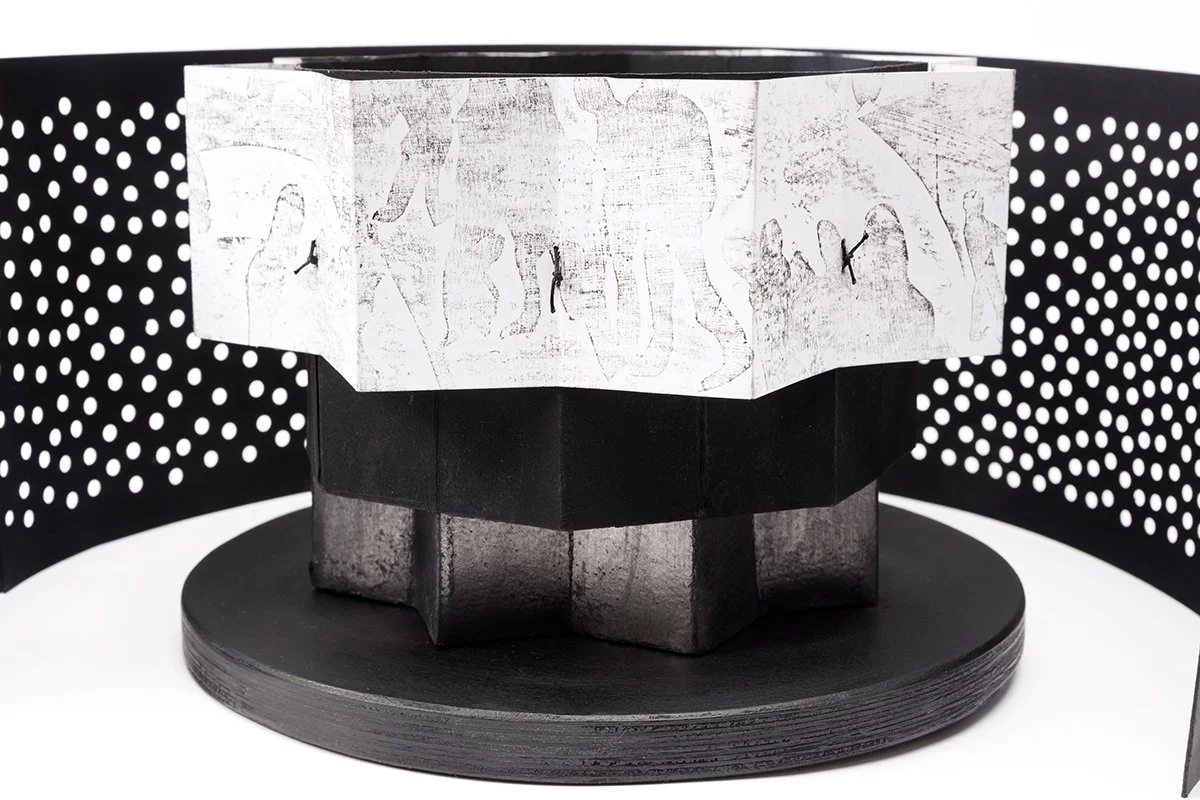
The Well, open
The history of obtaining bodies for scientific use has a troublesome past in both the United States and Europe (and perhaps elsewhere). Those among the most vulnerable – most often the enslaved – were exploited for scientific purposes. Unclaimed bodies from hospitals, jails, and poorhouses were also collected for study, a practice that continues to this day in most states. Most troubling was the illegal practice of stealing bodies, primarily from African-American burial grounds.
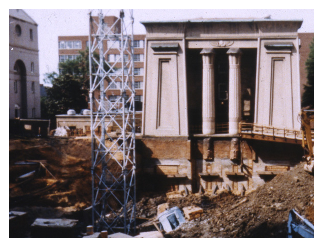
Kontos Building, VCU campus
Those bodies used for scientific study are generally disposed of by cremation or burial. However, at the Medical College of Virginia, the bodies were thrown down refuse wells located on campus. In 1994, a well containing dismembered bodies mixed with discarded bottles, clothing, and animal remains was discovered during construction. University administrators gave archeologists very limited time to carefully exhume the bodies before backhoe operators pulled buckets full of remains and refuse from the site. The university then filled and built structures over the well. It is estimated that at least an additional 10 feet of the well was not extracted before construction commenced. The gathered remains were sent to the Smithsonian Institution for analysis, however funding for testing was not provided and they sat in storage until 2011.
In 2011, a documentary filmed by VCU professor, Dr. Shawn Utsey, and a report written by biological anthropologists, Kari Bruwelheide and Douglas Owsley, brought the discovery and fate of the remains – estimates range between 45 - 55 persons, including 5 children – forward. Reconciliation efforts began with the creation of the East Marshall Street Well Project, and in 2013, the remains were returned to Richmond.
The Well is a memorial to all those who remain anonymously, and likely permanently, interred in wells on the VCU campus.
Researching this history was particularly troubling, however it was necessary in order to settle in my mind how to craft a memorial to these Ancestors – it should be silent, stately, composed, and solemn. It should most of all acknowledge their sacrifice, how they were disregarded in life and even in death, yet celebrate their humanity, and our connection to them.
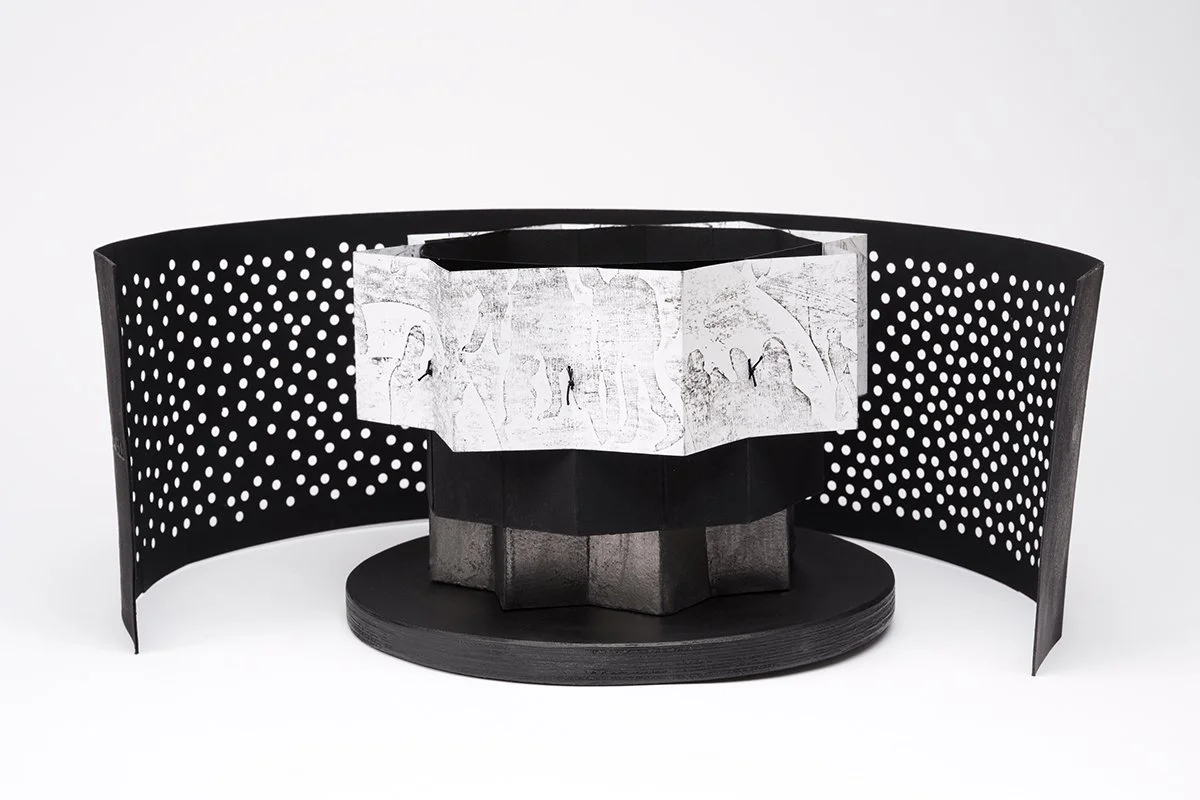
I decided it should be in the form of a circle – a continuity, an encircling, a protection, a round, and a shout. I imagined this book as a building, with the approaching visitor taking in the perforated façade encircling the structure. The façade pays homage to traditional African architectural screens and denotes absence while also allowing a peek at the structure of the book.
The screen opens to reveal both text and book structure, starting with the outermost layer - an accordion frieze frottaged from an impression of a Slave Trail marker obtained near the African Burial Ground on the front, and of plants collected from the area on the back.
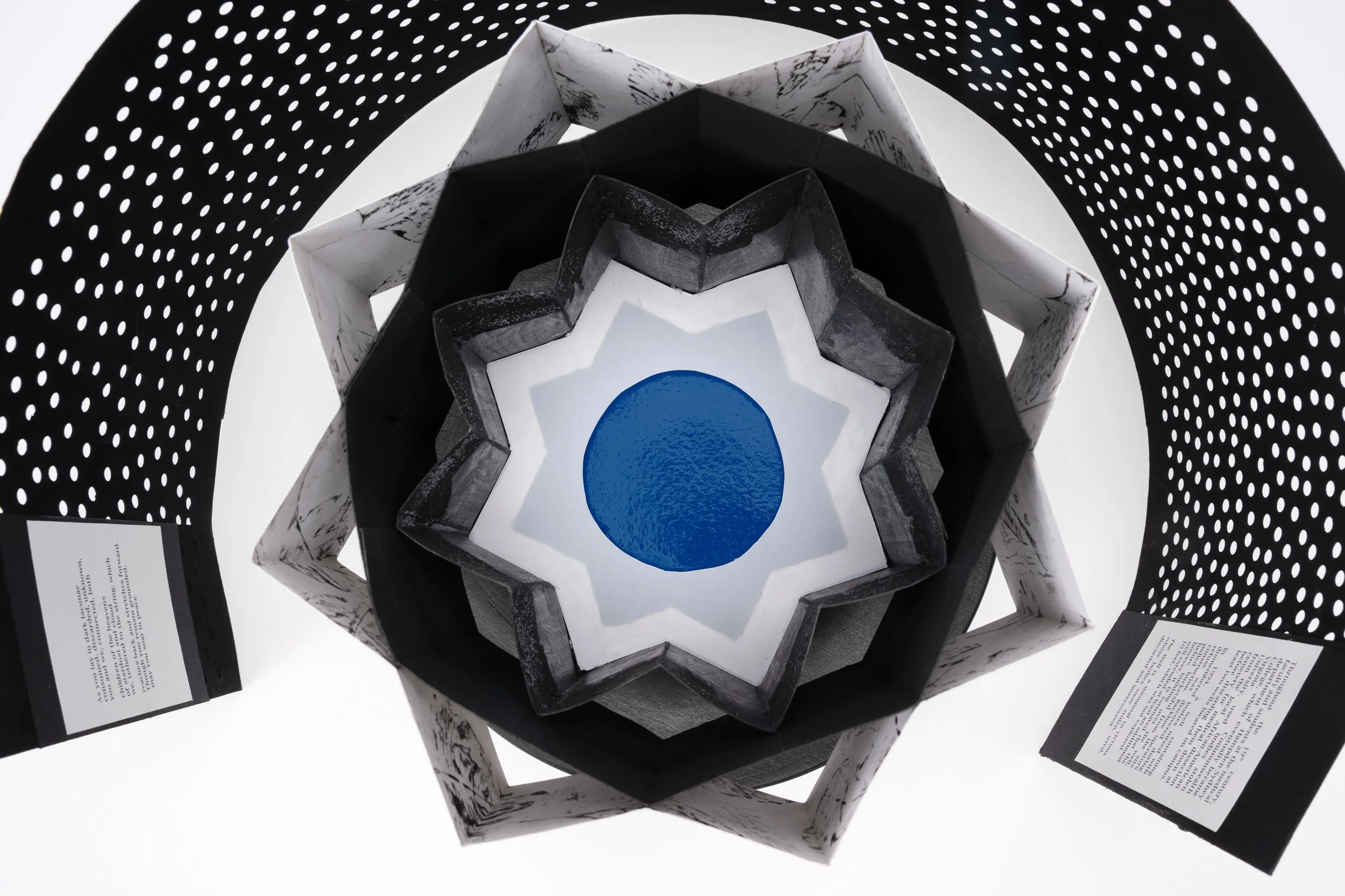
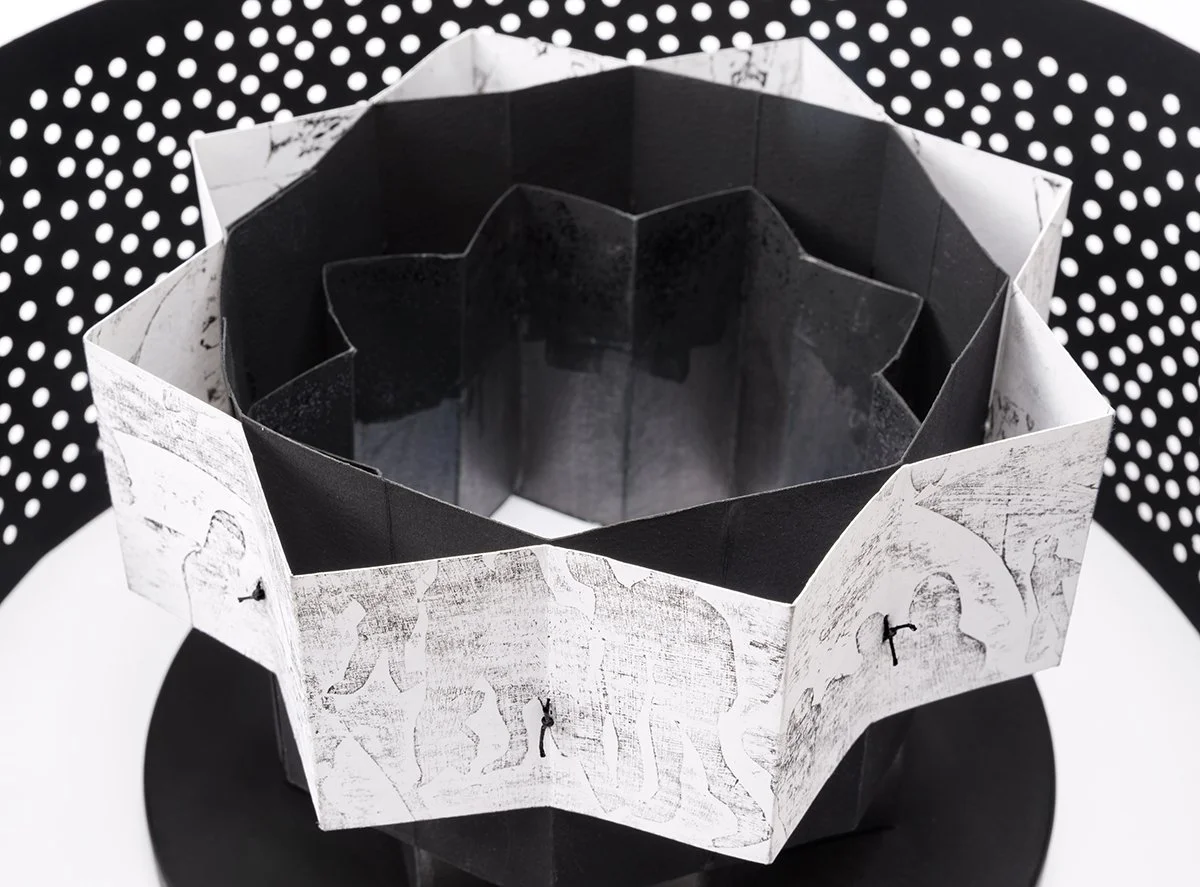
The Well, edition 1, open
The overall form of The Well is a 3-dimensional interpretation of a nsoromma, or star, an Adinkra symbol conveying watchfulness and protection. Nsoromma is a representation of the belief that we are all of the stars - connected through the divine.
And though made of paper, the surfaces are intended to have a solid presence. A metallic burnished surface, prepared with meditation and care, is juxtaposed against ultra matte surfaces.
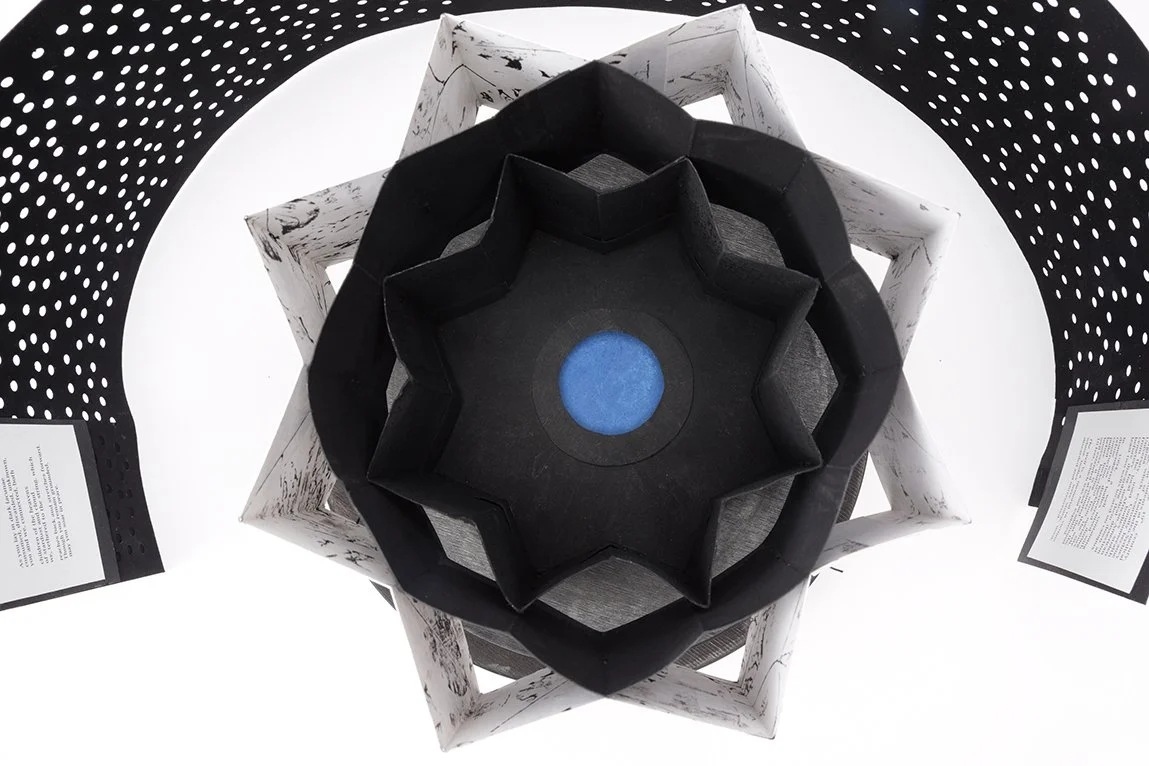
The Well, edition 2, open
Inside the structure are varying levels provided by stacked accordions and in the center of The Well, lies blue – a color whose significance traverses time; a color rooted in knowledge, patience, and spiritual practices across the African Diaspora. The blue paper was dyed at a Yourba indigo dyeing workshop with Gasali Adyemo early last year. I dipped the scraps – papers with history – into the vat as experiments, knowing they’d eventually be used in a project.
The Well is a variable edition of 2. Thank you to IBé for sharing the story that inspired this book, and to the College Book Art Association (CBAA), for awarding this project a Member Support Grant to facilitate completion. Coincidentally, as I was adding the finishing touches to The Well, IBé shared an announcement of construction of a memorial in honor of the victims.